Website Case Study
Anomaly Registry
Solved, debunked and unexplained cases side by side: a reference archive of 175 anomalous events, each one traced back to the record.
At a Glance
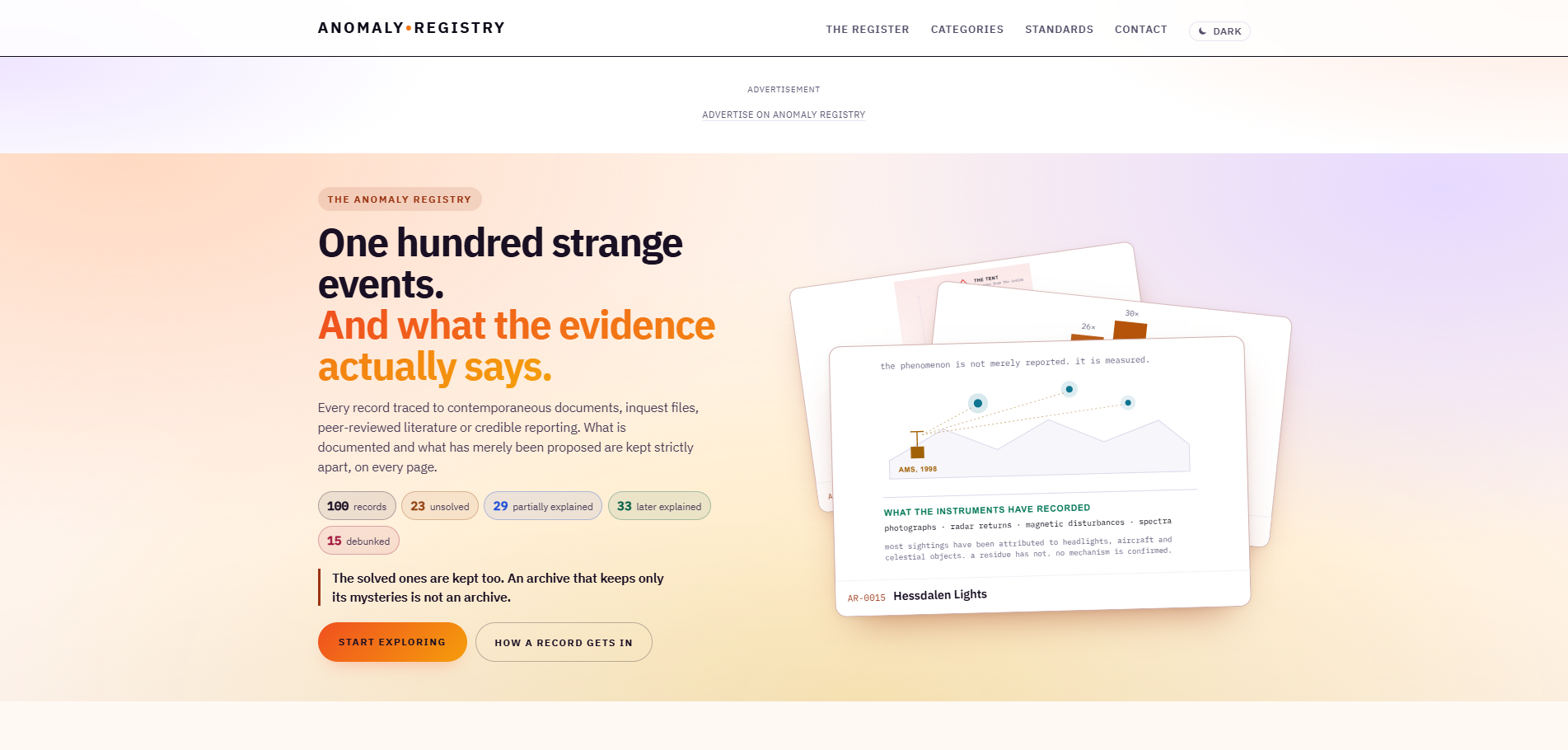
Anomaly Registry documents real-world anomalous events under a strict no-speculation policy. The register holds 175 records across seven categories and four statuses: unsolved, partially explained, later explained and debunked. Entries carry an original figure derived from their own data and a section on what the popular version gets wrong. We designed the site in IBM Plex with light and dark themes, and built it to run without a database.
- Project
- Website
- Sector
- Reference publishing: documented anomalies
- Scope
- Archive of 175 case pages with browse and categories
- Highlights
- Combined filters, world map, light and dark themes
- Live site
- AnomalyRegistry.com
The Brief
Strange events attract speculation. The registry had to be the opposite: a place where what is documented and what has merely been proposed are kept strictly apart on every page.
- Trace every record to contemporaneous documents, inquest files, peer-reviewed literature or credible reporting.
- Keep solved and debunked cases in the register, since an archive of mysteries alone is not an archive.
- Let readers search the register and filter it by status and category at the same time.
- Correct the popular version of each story in a clearly labelled section.
What We Designed
The home page opens with a plain statement, One hundred and seventy-five strange events, and what the evidence actually says, followed by a tally of the records by status. Cases such as the Dyatlov Pass incident, the Somerton Man and the Voynich manuscript lead into sections for cases solved and kept anyway, those comprehensively debunked and those most of the way there, then a browse by category.
We chose a modern, minimal look in IBM Plex Sans and IBM Plex Mono, the monospace giving case numbers such as AR-0001 the feel of a catalogue reference. Near-black ink with a faint violet cast sits on white, with a dark theme one click away. Each case figure is original and drawn from the record's own data, so the visuals stay as evidence-led as the writing.
Combined filters
The browse page pairs search with status and category filters that work together across the whole register.
Popular version corrected
Every entry includes a section on what the popular version of the story gets wrong.
World map
Recorded locations appear on a world map drawn before it reaches the browser, so it works with JavaScript turned off.
Two accessible themes
A toggle switches between light and dark, and each theme meets WCAG AA.
How We Achieved It
Under the design sits a deliberately simple system. Each record is written as a Markdown file, the single source of truth; a build step turns those files into JSON, and a PHP site serves the result, with no database to maintain. A new case starts life as a new file, which keeps the register easy to extend as it grows.
Every case lives at a readable address, such as /case/ar-0001/dyatlov-pass-incident/, which helps readers and search engines alike. The main navigation keeps to four places, the register, categories, standards and contact, and a skip link takes keyboard users straight to the register. A standards page sets out how a record gets in, so the editorial rules are public rather than implied.
Keep Exploring
More Case Studies

Want a Website Like This?
Let's talk about what your business needs, or start with a custom five-page website for $49 US a month.