Website Case Study
NYC Park Guide
New York City's parks and public spaces, rebuilt so that every one of more than a thousand verified entries can be found, read and shared on its own page.
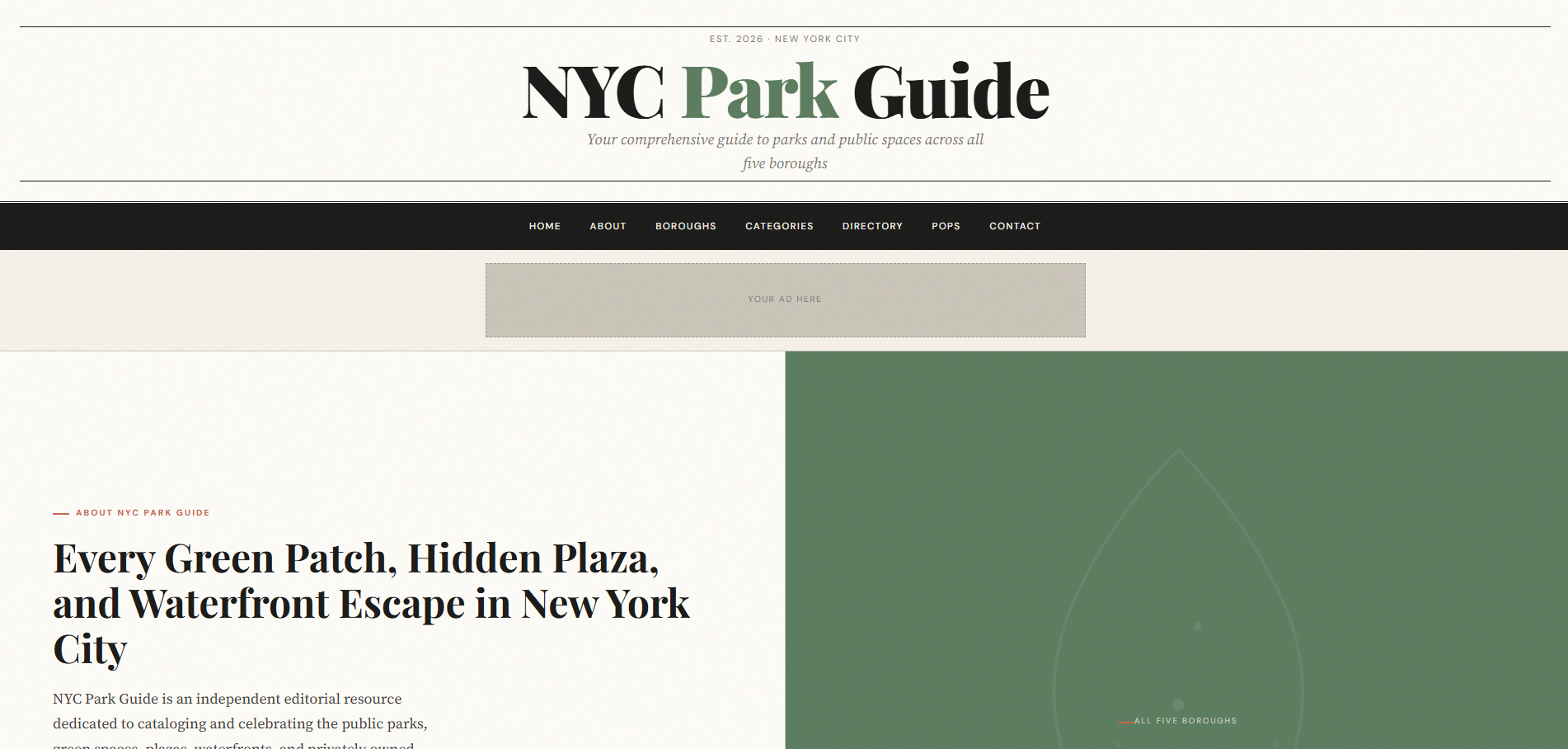
At a Glance
NYC Park Guide covers parks, gardens, plazas, waterfronts, playgrounds and privately owned public spaces across Manhattan, Brooklyn, Queens, the Bronx and Staten Island. Behind a clean editorial homepage sits a directory of more than a thousand verified entries, each with a page of its own, filed in five borough folders and reachable by borough or by category. Readers can also subscribe to a newsletter or get in touch through a contact form.
- Project
- Website
- Sector
- Parks and public spaces: city directory
- Scope
- Directory of over a thousand park pages in five boroughs
- Highlights
- Borough folders, six categories, POPS guide
- Live site
- NYCParkGuide.com
The Brief
A single page cannot do justice to more than a thousand public spaces. The guide needed a structure where every park can be found, checked and shared on its own, without losing the pleasure of browsing.
- Give every park and privately owned public space its own page, organized by borough.
- Let visitors browse by borough or by category, from playgrounds to waterfronts and piers.
- Shine a light on Manhattan's privately owned public spaces, the courtyards and plazas tucked behind towers.
- Check locations, dates and attributions across the entries so the guide can be relied on.
What We Designed
The homepage reads like the front of a city guide: a short masthead, an introduction to every green patch, hidden plaza and waterfront escape in the city, then five borough panels, each labelled with its county and listing signature parks such as Central Park, Prospect Park and Pelham Bay Park. A category section and a feature on Manhattan's privately owned public spaces follow, with notable examples to visit.
Three typefaces give the guide a serif-led, editorial voice: Playfair Display, Source Serif 4 and DM Sans. Near-black ink on a warm, paper-coloured background, with solid black buttons, feels closer to a printed field guide than a government portal, which suits an independent editorial resource and keeps attention on the places themselves.
A page per park
Every park and privately owned public space gets an individual page, filed in a folder for its borough.
Browse by category
Parks and open spaces; squares, plazas and malls; waterfronts and piers; playgrounds; gardens and natural areas; and POPS.
POPS guide
Manhattan has over 360 privately owned public spaces, and the guide picks out notable ones worth a visit.
Credited data sources
Entries draw on NYC Parks, NYC Open Data, the Department of City Planning POPS dataset and the Municipal Art Society.
How We Achieved It
We rebuilt the site from six pages into individual pages for every park and privately owned public space, organized into five borough folders. That structure gives each place its own address, title and description for search, and lets the homepage and borough pages link down to it cleanly. A deep fact-check pass verified locations, dates and attributions across the entries.
Privacy, cookie policy, terms of use, legal notice and accessibility each have a standalone page, while the contact form opens as an overlay so nobody loses their place in the directory. The newsletter signup and contact form are protected against spam with Google reCAPTCHA, and a clear note reminds readers to check access, hours and conditions before they set out.
Keep Exploring
More Case Studies

Want a Website Like This?
Let's talk about what your business needs, or start with a custom five-page website for $49 US a month.